How to Select 300 °C High-Temp Epoxy: Tg, CTE, and Interface Reliability
300 °C-class long-term endurance and 7.5 ppm/°C ultra-low CTE: SCITEO single- and two-component modified epoxy plus ultra-high-temperature systems for heat-resistant bonding and sealing
Abstract
A temperature rating is only the entry ticket. At SCITEO Advanced Materials, the criteria for high-temperature service come down to three measurable quantities: the glass transition temperature (Tg) sets the ceiling for structural load-bearing, the coefficient of thermal expansion (CTE) decides whether a dissimilar-material interface gets pulled apart by thermal strain, and the thermogravimetric analysis (TGA) weight-loss curve establishes the service-life boundary of the polymer backbone. The failure pattern seen most often in the field is far more specific: a respectable temperature rating, and then delamination from a ceramic-to-metal interface after a few hundred hours at 250 °C, because Tg and CTE were never aligned with the actual service temperature profile.
Epoxy adhesives hold the leading position across aerospace, precision sensing, semiconductor equipment, and high-end motor manufacturing. Formulations are highly designable, mechanical and electrical properties are balanced, and one chemistry can serve dispensing, screen printing, potting, and impregnation at the same time, a combination few other resin systems can match. As wide-bandgap semiconductor processes, precision gas sensing, and high-voltage drive platforms push service temperature and power density up together, the question has shifted from whether a material can survive a given temperature to whether it can hold the interface intact under the integral of temperature over time and under multi-axis thermal stress.
Those three boundaries also organize the product platform, which spans single-component structural bonding, two-component low-viscosity potting, and ultra-high-temperature composite systems, with the temperature range extending to 1800 °C. What follows are criteria that can be transferred directly into a selection document and a process specification, not a set of attractive numbers measured at room temperature.
Core Parameter Comparison
The table below places the SCITEO high-temperature epoxy platform and conventional high-temperature adhesives on the same basis. The test-standard column states where each number comes from.
| Parameter | SCITEO Solution | Industry Standard | Test Standard |
|---|---|---|---|
| Long-term temperature limit | 300 °C (400-1800 °C ultra-high-temp composite systems) | 150-200 °C | TGA / long-term heat aging |
| Peak Tg (two-component) | 280 °C | 120-180 °C | DMA / DSC |
| CTE (below Tg) | 7.5-48 ppm/°C | 50-80 ppm/°C | TMA |
| Post-cure hardness | Shore D 84 | Shore D 70-80 | ASTM D2240 |
| Lap shear strength on grit-blasted steel | ≥20 MPa | 5-15 MPa | GB/T 7124 |
| Insulating-grade shear strength | ≥26 MPa (≈3800 psi) | Below 2000 psi | ASTM D1002 |
| Strength retention after 250 °C × 500 h | ≥92% | ≈70% | 250 °C heat aging + lap shear |
| Step cure schedule | 80 °C/1h + 120 °C/1h | Direct cure at 150-180 °C | DSC |
Temperature data has to carry a time qualifier, and that is the dimension selection documents drop most often. The same adhesive can differ by an order of magnitude in usable life between 250 °C and 300 °C, so SCITEO always states heat endurance as a temperature-and-time pair, for example the strength retention measured after 250 °C × 500 h heat aging, rather than a single peak number. The test-standard column in the table exists so that pair can be verified, and a datasheet that lists a temperature without a duration cannot be turned into a life estimate or compared against another supplier.
Engineering Definition of a High-Temperature Adhesive
There is no single industry definition of heat resistance. It depends on the integral of temperature over time and on the amplitude and frequency of thermal cycling. Under demanding conditions, a qualified organic high-temperature adhesive normally sits in one of three threshold classes:
- Long-term thermal fatigue: 1 to 3 years of cumulative service at 120-175 °C, or 2,000 to 4,000 hours at 200-230 °C without cohesive failure.
- Medium-term extreme endurance: 200 to 1,000 cumulative hours at 260-370 °C.
- Short-term thermal shock: 230-280 °C for several minutes during wave and reflow soldering, with no property loss after one, two, or even three soldering passes.
The third class looks like the easiest to clear, and it eliminates the largest number of suppliers.
Real duty cycles rarely sit inside only one class. Over its service life a device usually sees long-term moderate-temperature aging, intermittent peak thermal shock, and thousands of thermal cycles at the same time, and those loads damage the network differently: aging is dominated by chain scission and oxidation, while cycling is dominated by interfacial shear fatigue. Acting together they accumulate damage faster than either mechanism does alone, so failure arrives earlier than a projection built on a single temperature point would suggest. In selection reviews, SCITEO asks for the service temperature profile and the cycle count, then matches the temperature class and the cure schedule to that data. A single maximum temperature value rarely leads to a workable design.
Core Performance Metrics and Failure Defense Under High Temperature
Holding those thresholds depends on whether the molecular network gets several things right at once.
Thermogravimetric Analysis (TGA) and Glass Transition Temperature (Tg)
High-temperature failure of a polymer starts at two boundaries. Backbone scission and oxidative decomposition are chemical boundaries, described by the TGA curve. Modulus collapse with temperature is a mechanical boundary, located by Tg. Neither substitutes for the other, and neither is sufficient on its own.
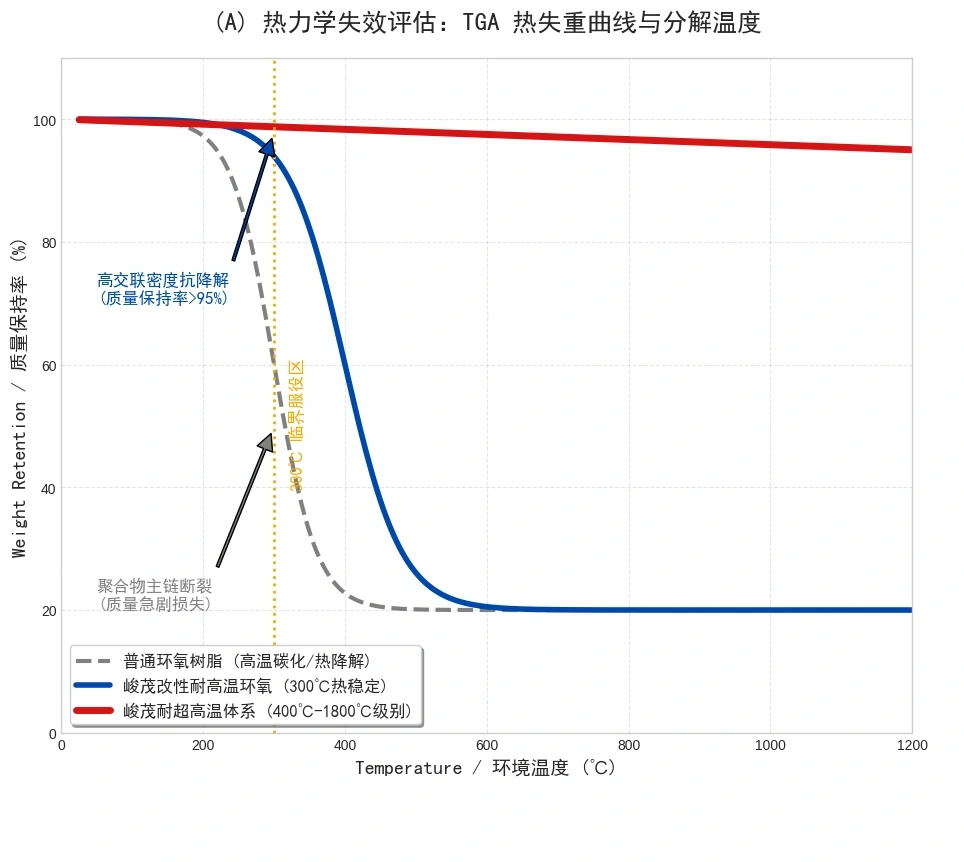
The TGA curve sets the decomposition temperature and the upper limit of long-term thermal aging life. A high-temperature adhesive needs a sufficiently high onset-of-weight-loss and decomposition temperature, commonly judged by the 5% weight-loss temperature (Td5), to guarantee thermophysical and thermochemical stability. Tg marks the transition from the glassy to the rubbery state. Once service temperature crosses Tg, storage modulus falls quickly and shear strength decays with it. SCITEO modified epoxy systems rebuild the crosslink network with multifunctional epoxy resins and cycloaliphatic curing agents, raising crosslink density and bond-scission activation energy. That pushes the two-component peak Tg to 280 °C and keeps the 3.9 GPa room-temperature modulus in place under sustained heat.
Tg and the temperature limit are two distinct physical quantities. Tg describes the modulus inflection point, while the temperature limit describes how long chemical bonds stay stable over time. Crossing Tg is not failure either: the modulus of a highly filled crosslinked system drops noticeably above Tg, but the inorganic filler network still carries load and interfacial strength can stay inside a usable band, which is why a 300 °C-class long-term rating and a 280 °C peak Tg can coexist. The real life boundary is set jointly by the backbone's weight-loss rate at that temperature and by how fast interfacial shear stress accumulates, and it needs both a TGA curve and mechanical retention after heat aging behind it. Neither a peak temperature nor a single Tg reading can be extrapolated into a service life.
Measured Tg also depends heavily on the test method. DSC reads the transition midpoint from a heat-flow change; DMA reads the temperature at which storage modulus drops sharply. The same sample can differ by more than ten degrees Celsius between the two, and raising the heating rate from 5 °C/min to 10 °C/min shifts the reading further. A selection document has to state both method and heating rate, or Tg values from different suppliers cannot be compared at all. SCITEO reports Tg on a DMA basis at 10 °C/min and keeps the raw curves in the report.
Cyclic Thermal Stress and CTE Matching
Interfacial failure under thermal cycling traces back to shear stress accumulated from CTE mismatch. The cohesive strength of the adhesive usually still has margin; the stress limit is what gets exceeded first.
Under cyclic temperature change, substrate and adhesive generate continuous shear stress because their coefficients of thermal expansion differ. Silicon sits near 2.6 ppm/°C, copper near 17 ppm/°C, aluminum nitride near 4.5 ppm/°C, aluminum oxide at 7-8 ppm/°C, and stainless steel and nickel-based alloys in the 10-17 ppm/°C band, while Kovar is as low as 5-6 ppm/°C. A conventional rigid epoxy generally exceeds 50 ppm/°C. Layers in one structure expand and contract out of step, the accumulated strain converts into interfacial shear stress under Hooke's law, and once it exceeds adhesive strength the result is cohesive failure or interfacial delamination.
Selected SCITEO products hold CTE at 48 ppm/°C below Tg, with the lowest reaching 7.5 ppm/°C by TMA measurement, forming a stress buffer between metal and ceramic. One lesson from the in-house laboratory is worth repeating: CTE data is only meaningful for selection below Tg, and it has to come from the same TMA and DMA curves as the reported Tg. Above Tg, expansion is governed by segmental motion and the number loses comparability.
Lower CTE is not automatically better. Pushing CTE down usually means raising the volume fraction of inorganic filler, and filler raises modulus at the same time, which can increase the stress the interface has to carry. For large-area interfaces such as ceramic plates and metal bases, bond line thickness (BLT) and cure shrinkage belong in the evaluation too, so that local stress concentration does not precede global instability. SCITEO adjusts filler packing, coupling agents, and flexible segment ratios together on these interfaces so that low CTE and low stress stop working against each other.
Processability and Combined Performance
Packaging houses score an adhesive across heat resistance, rheology, thermal conduction, insulation, and flame retardancy at the same time. Falling short on any one of them is a rejection.
Single-component systems target ready-to-use handling and high-speed dispensing; two-component systems target low-viscosity penetration and void-free cavity filling. Together they form the process foundation of the SCITEO heat-resistant platform. For micro-cavities and fine gaps, the material has to balance low viscosity against high filler loading: viscosity sets penetration speed, filler sets cured strength and CTE, and thixotropic index plus pot life determine whether it can run on an existing dispensing or potting line.
The trade-off between lower viscosity and higher filler loading is real. SCITEO resolves it by splitting formulations by process. Dispensing and screen printing need moderate thixotropy and shape retention; potting and impregnation need lower initial viscosity and longer flow time. Both formulations share one heat-resistant backbone, which means reliability data can be reused across processes and a customer switching processes does not have to repeat the full validation.
High-Temperature Epoxy Product Lines and System Segmentation
SCITEO splits its high-temperature products into four lines mapped to different package architectures and temperature ceilings: single-component modified epoxy, two-component modified epoxy, thermosetting silicone, and the ultra-high-temperature composite systems that go beyond what organic chemistry can deliver.
Flexible Anti-Aging: Thermosetting Single-Component Silicone
The Si-O backbone gives silicone broad-temperature flexibility, with a short-term limit of 280 °C and an elongation at break far above any epoxy system.
- Strength: high elongation absorbs structural internal stress, and anti-aging performance under thermal cycling is excellent. SCITEO's thermosetting formulation solves the deep-cure problem silicone otherwise has inside closed cavities.
- Constraint: low modulus and comparatively limited shear strength, and the interface is easier to peel for rework. It does not suit high-stress structural fixation.
Structural Strength: Single-Component High-Temperature Epoxy
For sensors and precision assemblies that need high-load support, single-component epoxy is the more direct answer.
- Handling and strength: ready to use with no pot-life constraint, compatible with high-speed dispensing and screen printing. Post-cure hardness reaches Shore D 84 (ASTM D2240), lap shear strength on grit-blasted steel is ≥20 MPa (GB/T 7124), and modulus is 3.9 GPa with impact resistance.
- Weathering and insulation: insulating, corrosion-resistant, and permanently crosslinked once cured, so it is not reworkable. Sealing can be verified by leak and helium testing. Long-term temperature grades are assigned by duty cycle: the general grade is backed by 250 °C × 500 h heat-aging data, and a specialty grade for sustained high-temperature duty withstands continuous exposure at 300 °C for four days (96 h). Temperature and duration are always quoted as a pair, which reflects real margin better than a single peak number.
For the SCITEO single-component epoxy system specifically, heat-cured shear strength reaches 29 MPa, strength retention is 92% after 500 hours at 250 °C, and 85% after 500 thermal cycles from −40 to 125 °C. That suits high-temperature sensors and power components that have to survive multiple reflow passes and leak verification. These figures come from in-house testing on the same sample batch, so engineers can compare them directly during selection instead of assembling single data points from different sources.
Precision Potting: Two-Component High-Temperature Epoxy
For complex micro-cavities and very fine interconnects, the two-component (A/B) system offers a distinct rheological advantage.
- Low-viscosity penetration: after mixing it flows at low viscosity and fills complex structures uniformly, without voids.
- Extreme performance: high post-cure hardness, insulating-grade shear strength above 26 MPa (≈3800 psi, ASTM D1002), and no degradation under continuous 250 °C. Potting duty that has to hold high temperature over long periods should use a two-component system backed by post-aging strength retention data, not by a TGA curve alone.
- Low CTE and visual freedom: low CTE delivers long-term bond reliability for micro-components, a hidden metric most high-temperature adhesives overlook. Beyond standard colors, SCITEO has solved the high-temperature bottleneck of transparent epoxy, offering clear high-Tg grades with color matching and custom filler options.
Process risk in two-component systems concentrates on mixing uniformity and working time. Metering deviation or incomplete static mixing leaves locally under-cured zones, and those zones tend to become crack initiation sites in high-temperature service. SCITEO recommends validating mix ratio, dispensing accuracy, and pot life on the production line, writing the step cure schedule into the process document, and confirming degree of cure in deep cavities and thick bond lines with DSC residual exotherm.
Beyond Organic Limits: Ultra-High-Temperature Systems
In duty cycles such as aero-engine sensors and industrial combustion or heat-treatment equipment, a 300 °C-class epoxy has no usable margin left, and conventional polymers will carbonize.
For that temperature range SCITEO moves the material system off the organic network entirely, to ultra-high-temperature composite systems rated from 400 °C up to 1800 °C, holding insulation and structural integrity within one formulation platform. In selection terms it complements the epoxy platform rather than replacing it, serving the most severe combustion and extreme-heat environments.
Technical Charts and Data Models
To show material reliability in extreme thermal environments directly, the SCITEO application engineering team established two physical model curves.
TGA mass-retention curve:
Shear strength decay under high temperature:
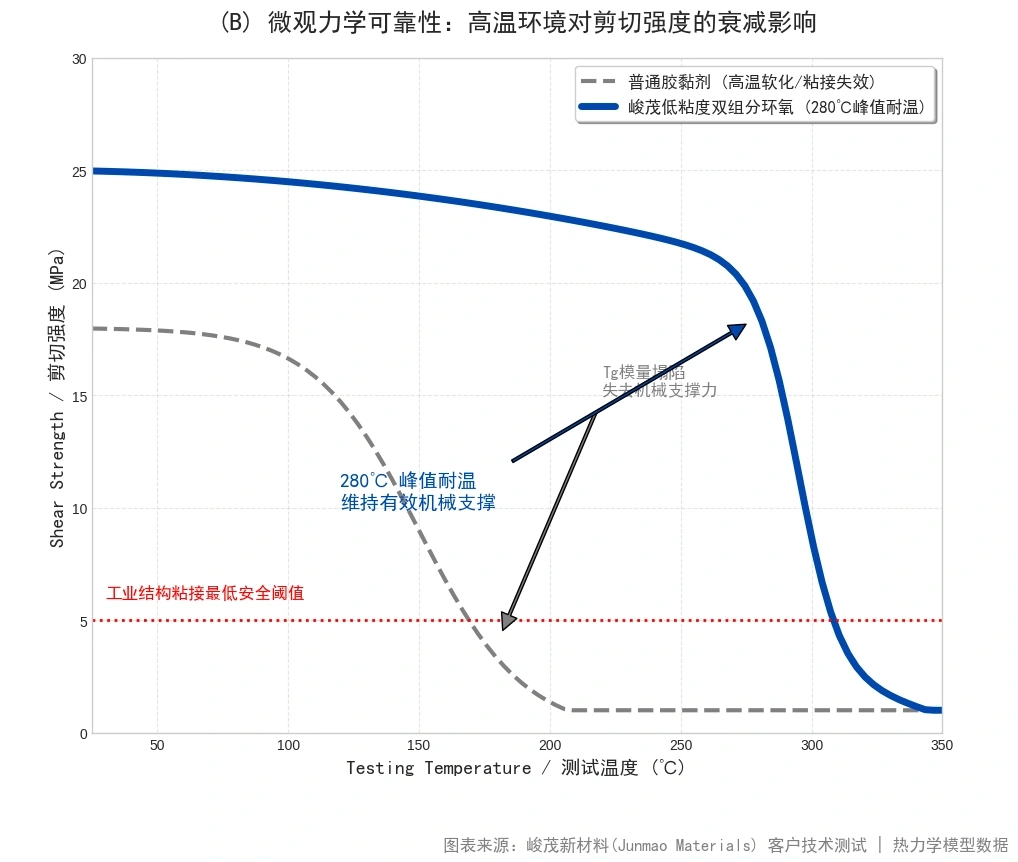
Read the two curves on the same temperature axis. The TGA curve gives the range in which the backbone begins to lose mass significantly; the shear strength decay curve gives how fast load capacity falls with temperature. If strength decays well before mass loss appears, failure is dominated by Tg or interfacial stress, and network rigidity plus CTE matching should be optimized first. If both fall together, the answer lies in backbone chemistry. SCITEO technical support typically asks for both curves before deciding the direction of a formulation change.
SCITEO Solutions for Three Extreme Duty Cycles in Advanced Manufacturing
Demand across the three duty cycles below is rising at once, and they share one requirement: heat resistance alone is no longer enough. Insulation, low stress, and process window all have to be satisfied at the same time.
Semiconductor Front-End Equipment: High-Temperature Bonding at Ceramic-to-Metal Interfaces
Front-end equipment parts stack temperature endurance, insulation, low CTE, and cleanliness onto a single interface. General-purpose structural adhesives rarely satisfy all four at once.
Inside etch, physical vapor deposition, and chemical vapor deposition chambers, parts such as electrostatic chucks (ESC), ceramic heaters, showerheads, chamber viewports, and vacuum transfer end effectors operate in alternating heat, vacuum, and RF fields. Ceramic plates are commonly made of aluminum nitride (AlN) or aluminum oxide (Al₂O₃) and must bond to metal cooling bases with high strength and low thermal resistance. Working temperature covers room temperature up to above 300 °C, and advanced nodes demand short-term peaks even higher. Once the interface destabilizes under thermal cycling, the consequences land directly on wafer temperature uniformity, particle contamination, and tool downtime.
Four questions have to be answered: the long-term temperature ceiling of the interface; CTE matching between ceramic and metal; insulation stability under combined electric field, heat, and vacuum; and freedom from contamination and condensable volatiles (CVCM / TML) during cure. The SCITEO high-temperature epoxy system for this direction builds on a 300 °C-class long-term rating and a 280 °C peak Tg crosslinked network. CTE of 7.5-48 ppm/°C below Tg buffers between aluminum nitride, aluminum oxide, stainless steel, and aluminum alloy. Shear strength above 20 MPa on grit-blasted steel locks the structure, and insulating-grade shear strength above 26 MPa covers insulation and strength together. Parts that need fine-gap or micro-cavity filling use the two-component low-viscosity system with a step cure (80 °C/1h + 120 °C/1h) to crosslink at a lower thermal budget, with ramp rates controlled during cool-down to reduce residual stress on thin-walled ceramic structures.
SCITEO also supplies transparent high-Tg epoxy for chamber viewports and sensor windows that need optical inspection or alignment observation, holding the 300 °C class while meeting appearance and inspection requirements. For maintenance scenarios, the ready-to-use nature of single-component systems lowers on-site rework complexity.
Across the equipment life cycle, the bond line directly affects maintenance intervals. Only when the interface holds flatness and thermal resistance stable after tens of thousands of wafers processed can equipment makers and fabs extend service intervals and cut spare-part consumption. SCITEO validation paths for equipment customers typically include high-temperature aging, thermal cycling, and full-tool thermal testing, with the goal of surviving process qualification rather than stopping at sample data.
High-Temperature Gas Sensors and Aerospace Instruments: Sealing the Ceramic Sensing Element
The hotter a gas sensor runs, the more its failures concentrate at the interface between the ceramic sensing element and the metal housing, not in the sensing material itself.
Oxygen and nitrogen-oxide sensors used in automotive exhaust and industrial combustion control rely on zirconia solid-electrolyte ceramic elements that output a concentration-cell potential at high temperature, with operating temperatures above 600 °C, while oxygen probes for heavy-duty and industrial furnace duty run continuously at 700-1100 °C. The sensing element must be electrically connected through a metal housing and lead wires while staying hermetically isolated, because any leakage distorts the reference atmosphere and turns directly into signal drift and measurement failure. Temperature and pressure assemblies on aero-engine hot sections, gas turbines, and industrial furnaces face the same interfacial problem, compounded by high-frequency vibration and thermal shock.
The core difficulty is thermal expansion across a wide spread. Ceramic sensing elements typically sit near 10 ppm/°C, while stainless steel, nickel-based alloys, and Kovar fall in the 5-17 ppm/°C range. The bond line therefore sees shear cycling through repeated heating and cooling, and eventually fails as interfacial delamination or a cracked seal face. SCITEO introduces a low-CTE bond line between dissimilar materials as a stress buffer that spreads concentrated shear stress across the entire bond area. Single-component epoxy provides high-strength fixation and reliable sealing; two-component low-viscosity systems penetrate micro-cavities. One further lesson from these interfaces: thicker bond lines amplify shear strain under thermal cycling, and failure cross-sections usually appear in the thickest region of the bond line.
Ceramic-to-metal joining has three established routes: glass sealing, brazing, and adhesive bonding. Glass sealing and brazing tolerate higher temperatures, at the cost of high process temperatures and tight expansion matching between dissimilar materials. Adhesive bonding cures at lower temperature, offers transparent or insulating formulations, and is friendlier to heat-sensitive elements. Practice layers by temperature class: above 800 °C, glass sealing and brazing dominate; structural fixation, insulation, and sealing in the 300-800 °C band are handled by high-temperature epoxy and ultra-high-temperature systems. The two approaches complement each other. Above 400 °C the formulation switches to ultra-high-temperature composite systems rated from 400 °C to 1800 °C while holding insulation and structural integrity.
High-End Motors and Drive Systems: Stator Insulation and End-Winding Fixation
Motor insulation failure is the combined result of thermal, electrical, mechanical, and environmental stress. Stator potting funnels all four stress paths into one adhesive layer, so selection has to be evaluated as a duty-cycle combination. Splitting the four apart and picking the best score on each leads to the wrong answer.
Stators for industrial servo and spindle motors and for new-energy vehicle traction motors are moving toward higher slot fill, higher speed, and higher voltage platforms at the same time. Hairpin windings raise bare-copper slot fill from 40-45% with round wire to above 70%, at the cost of compressing turn-to-turn and layer-to-layer gaps below 0.5 mm, with some designs down to about 0.28 mm, where atmospheric impregnation can no longer guarantee void-free penetration. The thermal side is equally clear: copper conducts at roughly 400 W/(m·K), but the effective radial path through the winding is blocked by enamel film and air gaps in the slot, so effective radial thermal resistance runs orders of magnitude above the axial path. Heat therefore converges at the end windings, which have neither iron core nor housing as a heat path. In measurement, unpotted stator ends reach 188-190 °C at full load, already close to the 180 °C ceiling of class H insulation. Potting replaces the air in winding gaps (about 0.026 W/(m·K)) with a thermally conductive compound, bringing end-winding temperature down by roughly 30 °C. End-winding temperature rise sets insulation life directly, so heat path and insulation are the same problem here.
Selection has to resolve five constraints at once: the heat extraction path at the end windings; CTE matching against copper windings and silicon steel laminations; chemical resistance to oil or water cooling media; electrical stress from nanosecond-scale pulse voltages under converter drive; and mechanical fixation of end windings at high rotational speed. Electrical stress is the most underestimated of the five. Once converter output rise time enters the nanosecond range, voltage distribution across the winding differs completely from line-frequency operation. Low-voltage converter-fed machines require a partial discharge inception voltage (PDIV) test before shipment, while medium-voltage and high-power-density designs are qualified under IEC 60034-18-41 and GB/T 22720.2. Because the compound is the dielectric between turns and at the winding ends, its cured dielectric behavior, its compatibility with corona-resistant enamel films, and its insulation retention after long-term thermal aging together decide whether the motor avoids partial discharge across its service life.
The SCITEO approach for this direction builds on a 280 °C peak Tg crosslinked network as the long-term thermal foundation, with CTE below 25 ppm/°C under Tg keeping mismatch low against copper windings and silicon steel laminations, and 27 MPa shear strength mechanically locking the end-winding structure. After 1,000 thermal cycles from −40 to 125 °C (TC1000), retained shear strength stays above 24 MPa, leaving stable margin for end-winding fixation under wide-temperature cycling. A two-component low-viscosity formulation penetrates deep slots and turn-to-turn gaps under vacuum, and step cure reaches a high degree of cure while lowering residual stress. For converter-driven electrical stress, SCITEO reconfigures the formulation around the customer's actual pulse rise time, voltage platform, and switching frequency, rebalancing Tg, CTE, thermal conductivity, and cure window, and jointly validates compatibility between the compound and the enamel film.
Conclusion
Bonding has taken its place alongside welding and mechanical fastening as one of the three core joining technologies, but in high-temperature applications its value sits in predictability. Sticking reliably is only the entry threshold. As semiconductor equipment parts, high-temperature gas sensors, and high-end motors keep raising service temperature, a heat-resistance label on its own cannot support a selection decision.
A selection document that actually works states four things: the service temperature profile and peak duration; the CTE and interface dimensions of each dissimilar substrate; the number of heat-aging and thermal-cycling rounds already validated; and whether the cure schedule fits the production takt. SCITEO Advanced Materials works from Tg control, CTE matching, and long-term thermal stability to deliver structural bonding and potting across the full 300 °C to 1800 °C range. Formulation development and validation are anchored in curve data, cycle counts, and batch consistency, so a selection conclusion can be reproduced, traced, and re-validated after a process change. Temperature grade, Tg, CTE, viscosity, and cure window are all formulation variables that can be reallocated and rebalanced against a specific duty cycle, instead of a fixed catalogue of part numbers to pick the closest match from.
This article is SCITEO Advanced Materials original technical content; unauthorized reproduction is prohibited.
Appendix: Process & Engineering Adhesive FAQ Index
In potting complex component cavities, how does SCITEO's low-viscosity two-component epoxy break the 'low viscosity means low Tg' trade-off while still delivering high-temperature performance?
The trade-off comes from the formulation route. The conventional method uses reactive diluents to reduce viscosity, and diluents disrupt backbone rigidity so Tg collapses. SCITEO instead pairs specialty multifunctional epoxy resins with custom low-viscosity cycloaliphatic curing agents, preserving flow and micron-scale gap penetration without diluents. The cured network is dense enough to support a 280 °C peak Tg and no degradation at 250 °C long term.
When packaging dissimilar materials such as ceramic and metal (stainless steel, copper, Kovar) at the 300 °C class, how is interfacial shear delamination prevented?
The failure is mechanical tearing from CTE mismatch, and the cohesive strength of the adhesive itself usually still has margin. In a conventional adhesive, interfacial shear stress under a 300 °C expansion differential quickly exceeds the load limit. SCITEO 300 °C-class epoxy holds CTE at 7.5-48 ppm/°C below Tg (TMA-measured), forming a stress buffer between metal and ceramic that dissipates destructive thermo-mechanical stress at the micro-mechanics level, while lap shear strength above 20 MPa keeps the interface intact.
Does SCITEO 300 °C-class epoxy require equipment heated to 300 °C to cure?
No. Crosslink cure temperature and final heat endurance limit are two distinct physical concepts. SCITEO single-component and two-component systems typically use a step medium-temperature cure, for example 80 °C/1h plus 120 °C/1h, completing three-dimensional crosslinking at a low thermal budget. The resulting high-Tg backbone then withstands 300 °C-class long-term thermal exposure and short-term thermal shock above that. Compared with direct ultra-high-temperature cure, step cure lowers the residual stress from abrupt shrinkage.
Why do general-purpose structural adhesives fail in electrostatic chuck and ceramic heater bonding inside semiconductor front-end equipment?
Because the interface sees continuous heating plus vacuum and RF fields at once. A general-purpose epoxy lacks the temperature ceiling and CTE matching, so interfacial shear stress accumulates through thermal cycling until the adhesive is exceeded, producing delamination or cracking, which in turn degrades wafer temperature uniformity and raises particle contamination. Selection should lock in a modified epoxy with a 300 °C-class long-term rating, 280 °C peak Tg, CTE below 48 ppm/°C under Tg, and lap shear strength above 20 MPa, cured with a step profile to lower residual stress.
For stator potting in hairpin and high-voltage drive motors, why must converter electrical stress be evaluated together with heat resistance and CTE?
Because motor insulation failure combines thermal, electrical, mechanical, and environmental stress. Hairpin windings raise bare-copper slot fill above 70% and compress turn-to-turn and layer-to-layer gaps below 0.5 mm, so atmospheric impregnation struggles to guarantee void-free penetration; end windings also lack the iron core and housing as heat paths, and full-load temperature can approach the 180 °C ceiling of class H insulation. Add the electrical stress of nanosecond-scale converter pulses, and the cured dielectric behavior of the compound plus its compatibility with the enamel film become the deciding factor for partial discharge inception voltage. SCITEO high-temperature epoxy combines a 280 °C peak Tg, CTE down to 7.5 ppm/°C below Tg, and shear strength above 20 MPa to protect the heat path, thermal matching, and structural locking at the same time, and the formulation can be tuned to the actual pulse rise time and voltage platform.