High-Temp Conductive Adhesive: 300 °C SiC Die Attach to 1000 °C Sensors
SCITEO Selection Guide: 195 °C Ultra-High Tg and a Sub-28 ppm/°C CTE Structural Lock, Plus a 500 °C-and-Up Ceramicized Anti-Ashing Network, Covering Bare-Die Mounting, Compute Power Delivery and Deep-Well or Nuclear Measurement Points
Abstract
The question that comes up most often in a selection review is a simple one: can a high-temp conductive adhesive rated at 300 °C actually run at 200 °C continuously? The answer is not in the rating; it is in the mechanism. Across the 300 °C to 1000 °C range, soldering is the first process to drop out, because its melting point settles the argument before the design starts. Conventional conductive adhesives then fail in sequence: the polymer matrix carbonizes, Tg collapse destroys adhesion, and the percolation network physically tears apart. Interconnect failures rarely come from a single weak number: interfacial stress, polymer matrix, and electron path tend to degrade together on the same timescale. The temperature ceiling therefore comes down to whether the conductive network and the interfacial stress both hold once the material crosses Tg; a nominal temperature rating on its own does not answer that question.
This article follows interfacial mechanics and electron percolation theory: silver's oxidation resistance and free-electron density, the matched design of a 195 °C ultra-high Tg with a sub-28 ppm/°C CTE, and how chip-grade 300 °C conductive silver locks down SiC power-module die attach and the 800 V HVDC compute power chain. Further up the temperature scale, 500-1000 °C specialty adhesives take over the anti-ashing interconnect in deep-drilling logging, nuclear and aerospace sensors, and solid oxide fuel cells (SOFC) and electrolyzers (SOEC). SCITEO covers that whole span with a matrix of extreme-temperature conductive materials, from chip grade to industrial sensor grade, built on three routes: conductive adhesives, sintered silver paste, and sintered copper paste, for different junction temperatures and line capabilities.
Core Parameter Comparison
The table below benchmarks SCITEO high-temperature conductive adhesives against conventional conductive adhesives:
| Parameter | SCITEO | Industry Standard | Test Standard |
|---|---|---|---|
| Continuous temperature limit | 300 °C (500-1000 °C specialty grade) | 150-200 °C | TGA / long-term heat aging |
| Tg (glass transition temperature) | 195 °C | 80-120 °C | DMA / DSC |
| CTE (thermal expansion) | <28 ppm/°C | Above 100 ppm/°C | TMA |
| Thermal conductivity | 20 W/m·K | 1-5 W/m·K | ASTM D5470 |
| Volume resistivity | ≤4×10⁻⁵ Ω·cm | 10⁻³-10⁻² Ω·cm | ASTM D257 |
| Shear retention after 190 °C/1500 h | ≥90% | Visible decay | GB/T 7124 / JESD22-A103 |
| SiC MOSFET junction-temperature support | Glassy state up to 175-205 °C | Not viable | AEC-Q101 |
| High-temperature resistance stability | No surge | Percolation network rupture | ASTM D257 |
| Sintered silver thermal conductivity | 280 W/m·K | Solder below 65 W/m·K | ASTM D5470 |
| Sinter-bond process window | Metal bond at 200-250 °C | High-temp solder above 300 °C | MIL-STD-883 / TMA |
The Physics Underneath a Conductive Adhesive
By construction, a conductive adhesive is a composite: the polymer matrix carries mechanical adhesion, thermodynamics, and thermo-mechanical support, while the conductive filler carries electron transport and phonon heat paths. During cure, micro-shrinkage of the resin presses filler particles against one another until a continuous electron percolation network forms, moving the material from insulator into the conductive range.
Why Conductive Adhesives Use Silver: Oxidation Resistance and Free-Electron Density
Silver (Ag) has become the default filler for low-resistance conductive adhesives, and the reason is atomic structure.
Oxidation resistance: copper powder oxidizes readily in air into highly insulating copper oxide, sending resistivity up by orders of magnitude. Silver stays chemically inert from ambient through medium-high temperatures.
Conductivity of the oxidation product: silver oxide (Ag₂O) formed on silver surfaces in air is a wide-bandgap semiconductor with limited conductivity, but it decomposes back to metallic silver above roughly 300 °C. Across its temperature grades SCITEO encapsulates the silver flakes and blocks oxygen diffusion: the 300 °C chip grade does this with a highly crosslinked phenolic epoxy, while the 500-1000 °C specialty grades rely on a ceramicized skeleton, so the surface oxide decomposes back to metal under long-term heat and contact resistance stays low. Silver's known weakness is electrochemical migration and sulfide corrosion, so for long-term high-humidity bias or sulfur-bearing atmospheres, SCITEO evaluates silver sintering, copper sintering, and encapsulation protection together rather than resting long-term reliability on silver's chemical inertness.
The cost-reduction question that comes up most is whether copper powder can replace silver and bring down the cost of a conductive silver paste. The answer lives in oxidation kinetics: once copper forms an oxide layer at the bond interface, contact resistance is no longer controlled, and the lower material cost buys unpredictable electrical drift. The route that actually escapes the limit is copper sintering, which grows a metallic bond through densification instead of wrapping copper particles in resin; that route is covered in the copper-sintering section of this site.
Percolation Headroom: How Many Contact Points Survive Thermal Cycling
Resistivity responds non-linearly to silver loading, and past the threshold every extra point of silver buys less while costing rheology and bond strength. That percolation mechanism belongs to the fundamentals of conductive adhesives; in a high-temperature application what matters is the headroom above the threshold. Once the adhesive crosses Tg it expands, the silver flakes that conduct through physical contact get pulled apart, and a flattering room-temperature resistivity stops meaning much. SCITEO therefore builds redundancy around the threshold, using particle-size grading and surface treatment to keep enough contact points alive through thermal cycling and cure shrinkage. Pushing silver content to its limit buys a more brittle compound and a narrower dispensing window.
We have seen formulations pushed past 85% silver where the room-temperature resistivity looked excellent, at the cost of stringing during dispensing, a brittle cured layer, and edge cracking within a few dozen thermal cycles. Headroom is harder to design than a peak number, and it is worth more.
Two Channels, One Interface: Electron and Phonon Paths Hold Together
At temperature, a conductive adhesive carries two loads: current out of the die and heat out of the junction. The first depends on contact density and contact resistance between particles; the second depends on the heat path through the filler network and the interfacial thermal resistance.
Electrons and phonons do not cross a heterogeneous interface in the same way. When phonons carry heat across silver-resin and silver-plating interfaces, acoustic impedance mismatch scatters them into contact resistance; if that same interface develops micro-debonding over thermal cycling, thermal resistance typically rises faster than electrical resistance. SCITEO therefore accepts 20 W/m·K thermal conductivity (ASTM D5470) and ≤4×10⁻⁵ Ω·cm volume resistivity (ASTM D257 / ASTM D2739) as one paired specification on its 300 °C chip-grade conductive silver, so an electrically passing, thermally failing part never ships.
Room-Temperature Cure Limits and the High-Temperature Failure Chain
Room-temperature conductive adhesives are widely used in consumer electronics and field repair because they are easy to handle. Point the same chemistry at aerospace, high-end sensors, or advanced semiconductors, however, and its physical shortcomings are amplified, becoming the customer's most stubborn engineering problem.
What the Customer Actually Sees: Resistance Drift, Carbonization, Delamination
Drive a conventional room-temperature or low-temperature-cure adhesive above 200 °C and several failure modes compound:
Insufficient crosslink density and Tg collapse: room-temperature cure cannot build a dense 3D polymer network, so Tg typically lands at 80-120 °C. Once ambient temperature crosses Tg, free volume expands rapidly, CTE mutates by orders of magnitude, intermolecular forces weaken, and shear strength drops accordingly.
Percolation network rupture: volumetric expansion pulls apart silver particles that were in intimate contact. Physical contact breaks, resistivity rises sharply, and the joint reads as an open circuit.
Main-chain scission and carbonization: sustained heat cleaves the chemical backbone of conventional epoxy or acrylic resins. The adhesive yellows, embrittles, and eventually pulverizes, and its shear adhesion to metal is lost with it. Carbonized residue can even form stray conductive paths that contaminate precision insulation zones.
That is why the whole SCITEO high-temperature conductive adhesive line runs on pure heat cure and does not use room-temperature moisture cure or RTV systems for hot-side interconnects. Only heat-activated, high-density crosslinking delivers mechanical strength and electrical stability together.
On the rework bench these failures tend to show up together: a yellowed adhesive layer, measurable open joints, and carbon residue contaminating an insulation zone. Judged one at a time, none of them points clearly at the root cause, which is why we decompose the failure chain first and talk about selection second.
How SCITEO Qualifies High-Temperature Interconnects: HTSL, TC, Shear, Outgassing
No single number qualifies a high-temperature interconnect. SCITEO runs four test families as release gates:
High-temperature storage life (HTSL): long-duration storage at temperature following the JEDEC JESD22-A103 approach, tracking drift in both volume resistivity and shear strength to confirm the percolation network is intact.
Temperature cycling (TC): cold-hot cycling to JEDEC JESD22-A104, probing interfacial fatigue under CTE mismatch, with attention to adhesive edges and die corners.
Interfacial shear strength: die shear and lap shear evaluated against GB/T 7124 and MIL-STD-883 Method 2019, quantifying load margin in the matrix and at the interface.
Outgassing and cleanliness: total mass loss and collected volatile condensable materials measured to ASTM E595, serving vacuum-exposed space, aerospace, and optical links.
Automotive and industrial programs layer AEC-Q101 stress qualification and GJB 150A environmental testing on top; the same protocol carries across material switches, so customers at different junction-temperature grades, die areas, and line capabilities all assess against one evidence set.
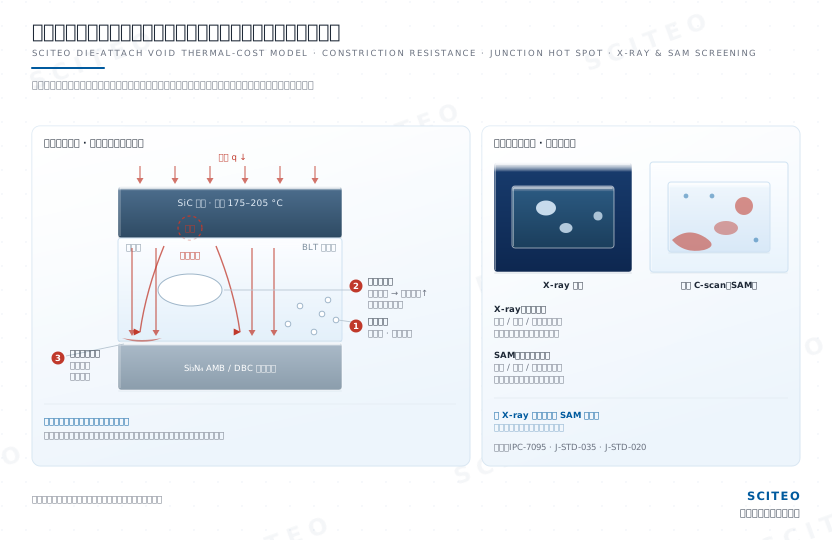
Chip-Grade Applications: SCITEO's 300 °C Conductive Silver System
In third-generation semiconductors such as SiC power MOSFETs, and in high-density packaging, junction temperatures have climbed well beyond what solder can carry. Leaded solder is banned on environmental grounds, and lead-free alternatives struggle to meet vibration and thermal-cycle requirements because of their melting point and brittle intermetallic compounds (IMC). The interconnect therefore moves from soldering to bonding and sintering, and the substrate side is migrating from direct-bonded copper (DBC) to silicon-nitride active metal brazing (Si₃N₄ AMB) to carry longer power-cycling life.
For this class of precision semiconductor work, SCITEO has developed a 300 °C chip-grade conductive silver adhesive for die attach and wire bonding on SiC and IGBT bare die, pairing low resistivity with generous thermo-mechanical headroom.
195 °C Ultra-High Tg and the 1,500-Hour Aging Protocol
The matrix is modified with a specialty phenolic epoxy. After cure it measures a 195 °C Tg by DMA/DSC, which means the material stays in a rigid glassy state up to 195 °C with no meaningful softening or volumetric step. SiC devices now operate at 175-205 °C junction temperature, a range where lead-free solder sits near its melting point and creeps quickly; a 195 °C Tg keeps the adhesive in its glassy load-bearing window, which is why SCITEO makes Tg its primary design variable.
1,500-hour aging data: after 1,500 continuous hours at 190 °C, the stress regime JEDEC JESD22-A103 HTSL is written to represent, the percolation network showed no degradation, and shear strength on silicon wafers, metal leads, ceramics, and glass substrates held above 90% retention (per GB/T 7124). That is the number a high-power chip running hot for years is really judged on: interfacial delamination margin.
A 195 °C Tg is often challenged as over-designed. We settle it on the junction-temperature distribution: SiC modules already peak at 175-205 °C, and with a 150 °C Tg the sustained full-load band is operating outside the glassy state, so the rated number and the measured life stop agreeing.
20 W/m·K Thermal Plus <28 ppm/°C CTE: A Paired Design
Waste heat that cannot leave a power chip quickly becomes thermal runaway. This system conducts as well as it bonds: graded silver and thermal fillers deliver 20 W/m·K thermal conductivity (per ASTM D5470) while forming a low-resistance electrical path and a low-thermal-resistance heat path in parallel.
CTE is the core reliability constraint in chip packaging. Silicon sits at roughly 2.6 ppm/°C, SiC near 4.2 ppm/°C, and a copper leadframe near 17 ppm/°C. If the adhesive in between exceeds 100 ppm/°C, a single 260 °C lead-free reflow or one cycle from −40 to 200 °C builds enough shear stress in the bond line to crack the die or peel the whole layer off the substrate. SCITEO's reformulated matrix holds CTE below 28 ppm/°C (TMA-verified), so expansion tracks the semiconductor and metal bodies, residual stress is cut at the source, and large bare die survive extreme temperature swings.
Die Attach's Fork: When to Move From Adhesive to Sintering
Once junction temperature passes 200 °C and power cycling runs into the hundred-thousand range, solder and conventional conductive adhesives both hit their ceilings, and the interconnect has to move to sintering.
How sintering forms a bond, and the pressure window it needs, belong to the die-attach fundamentals; what belongs here is the dividing line. Because the bond itself never melts, the device holds structural stability above solder's melting point. Traditional micron-silver sintering needs pressure in the 10 MPa range, while nano-silver and low-pressure pastes bring the window down to low-pressure or even pressureless operation, at the cost of higher sensitivity to surface state, drying method, and void control, plus warpage management on large areas.
Silver sintering and the 300 °C chip-grade conductive silver form a complementary pair: the adhesive covers heterogeneous-interface compatibility, reworkability, and total cost, while silver sintering covers extreme junction temperature and power-cycling life. Both share one reliability protocol and are selected against junction-temperature grade and line pressure capability.
On a comparison sheet, nano-silver paste, pressureless sintered silver, and copper sinter paste routinely sit side by side. The real differences are pressure window, atmosphere requirement, and surface preparation, not the thermal-conductivity column alone.
A third path has appeared in recent years: semi-sintered silver adhesive, also called epoxy-assisted sintering. The resin holds the silver in place first, then partial sintering fuses the particles into a denser conductive path, with thermal conductivity past 100 W/m·K and a more forgiving process window than full sintering. The trade-off is a division of labor between matrix and silver skeleton: the resin's Tg often sits at only 50-60 °C, so at temperature it is really the silver skeleton carrying the joint. Settle that question before selecting it: in long-term high-temperature service, is it the silver or the resin holding your interface together.
SCITEO Interconnect Upgrade for 800 V HVDC Compute Power
As AI compute clusters keep scaling, data centers have become the fastest-growing new growth engine for power semiconductors. Rack power has moved from tens of kilowatts to the megawatt class, and rack distribution is moving off the 48 V bus toward 800 V high-voltage DC (HVDC). NVIDIA's MGX-compatible 800 VDC power rack has entered its delivery window, and NVIDIA has joined Google and Microsoft through the Open Compute Project (OCP) to write that bus voltage into an open specification; the ±400 V three-wire Diablo 400 design that Google, Meta, and Microsoft are driving borrows mature components straight from the EV supply chain. The two topologies will coexist in the same data hall for years. A 1 MW rack on 54 V needs up to 200 kg of copper busbar, which is the physical reason the voltage has to climb. SiC and GaN devices split front-end conversion from near-load delivery. The architecture itself does not change the underlying constraints on the interconnect; the temperature and stress it brings do. Device junction-temperature ratings are being pushed from 175 °C toward 205 °C, and Infineon now lists 205 °C continuous operation for a 1300 V automotive SiC module, so the die-attach interface sits at a higher temperature for longer.
Liquid cooling has become mandatory in compute racks, and it reshapes the stress field at the interconnect: the temperature gradient between die, cold plate, and lid flips repeatedly during starts, stops, and load transients, so solder-layer creep and thermal fatigue surface first. SCITEO's 300 °C chip-grade conductive silver delivers glassy-state support for SiC power-module die attach at 195 °C Tg and a sub-28 ppm/°C CTE, while the silver-sintering route covers power-cycling scenarios at even higher junction temperatures. As compute density and supply voltage rise together, interface stability feeds through to rack-level uptime faster.
Extending to Higher Temperatures: SCITEO 500 °C to 1000 °C Industrial & Sensor Grade
Move into the near-field of an aerospace engine, an industrial robotic arm, a measurement-while-drilling (MWD) tool, or a specialty exhaust oxygen sensor, and service temperatures routinely exceed 400 °C and approach 1000 °C. In these non-chip applications, conventional conductive adhesives undergo irreversible ashing and combustion.
MWD/LWD: Compounded Vibration and Heat Loads
Thousands of meters down, in oil, gas, and geothermal drilling, the logging module behind the bit absorbs severe mechanical vibration while sitting in a 150-200 °C downhole ambient; the media often carry H₂S and CO₂, adding corrosion on top of heat. Conventional oil-and-gas MWD electronics stop at roughly 200-225 °C, while enhanced geothermal systems (EGS) are targeting reservoir temperatures of 250-400 °C. At Newberry, a >300 °C hot-dry-rock well has run more than 120 cumulative hours above 300 °C with zero MWD tool failures, moving the 300 °C class from prototype to field; beyond that, the >374 °C supercritical window still lacks electronics and interconnects that can serve long-term. Tool-level thermal capability is still running behind the reservoir, so the interconnect has to carry the margin. That is exactly where SCITEO's 500 °C-grade adhesive sits: a high-strength electrical connection that keeps high-temperature board components attached, holding drilling-vibration peel-off on solder joints to a minimum so the signal chain has a chance to stay continuous.
Nuclear and Aerospace Piezoelectric Vibration Sensors
High-end piezoelectric sensors monitoring nuclear main pumps or turbine blades must hold stable electrical connections between piezo ceramic and signal electrodes at 500 °C to 800 °C. Conventional silver paste needs very high sintering temperatures and stays brittle after cure. SCITEO's 1000 °C-grade adhesive takes a moderate-temperature cure, first building a hard ceramicized network and then holding silver-particle contact through high-temperature service, so high-frequency vibration signals show no measurable decay over long duty. Sensing cores themselves are moving to SOI, silicon-carbide piezoresistive and sapphire or aluminum nitride (AlN) piezoelectric structures, which raises the temperature ceiling and low-stress requirements on the interconnect in step.
SOFC and Electrolyzer Interconnects
Solid oxide fuel cell stacks run at 800-1000 °C; solid oxide electrolysis (SOEC) for hydrogen operates in the same window, with oxygen-ion conducting routes concentrated at 800-1000 °C and proton-conducting routes moving the window down to 500-750 °C. Whether generating power or hydrogen, current-collector bonding between cells must hold a low-resistance electron path through alternating oxidizing and reducing atmospheres, and SCITEO's ultra-high-temperature conductive adhesive brings heat and oxidation resistance to that interface.
Embodied AI and Low-Altitude Electric Propulsion: Hot-Spot Interconnects in Joint Actuators
The production ramp of embodied AI and humanoid robotics has pushed power density to a new level. A mainstream humanoid carries 40-80 joint motors, and volume platforms mount the servo drive inside the joint housing, right against the motor heat source, where local ambient can reach 150-200 °C on top of high-frequency start-stop and continuous vibration. Actuators dominate the bill of materials, so every hot spot inside the joint erodes runtime and dynamic response. eVTOL and electric aviation propulsion units demand higher current density and thermal margin under strict weight limits. The requirement for the interconnect has shifted from "conducts" to "stays stable under compounded heat and vibration." SCITEO's 300-500 °C-grade adhesive handles power-stage and sensor-stage electrical connection and the thermal path, trading temperature headroom above the duty cycle for service life and maintenance interval.
Limit Performance: Oxidation, Chemical Resistance, Stable Resistance
SCITEO 500 °C and 1000 °C specialty adhesives prioritize a heat-resistant backbone and a ceramicized network in their formulation, so volume resistivity runs slightly higher than the 300 °C chip-grade product; in this temperature range, selection already ranks structural integrity above the lowest possible resistivity. After a moderate-temperature cure, resistance to collapse and pulverization under superheated, corrosive gas flow is judged from the volume resistivity curve after long-term heat aging, not from a single data point.
Choosing the Interconnect: Solder, Conductive Adhesive, or Sintering
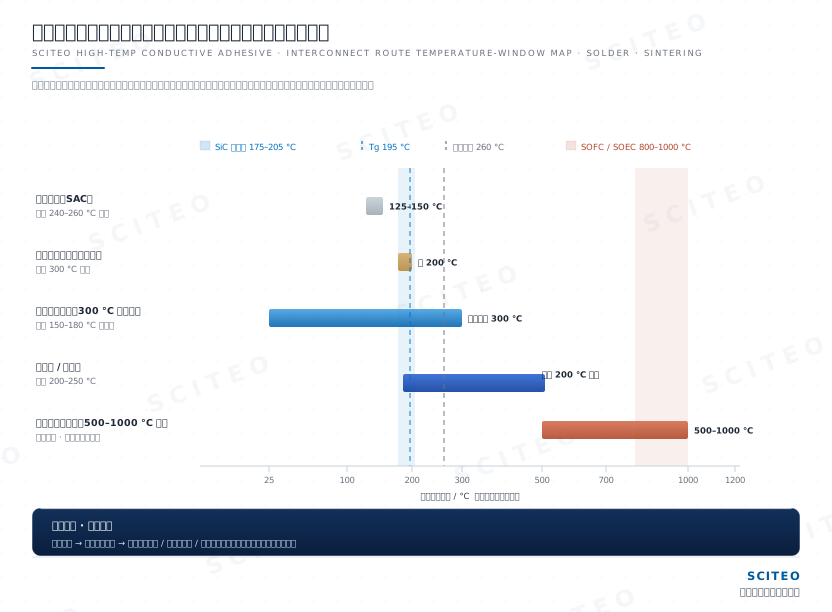
Four constraints set the boundary of each interconnect route: junction temperature, bond area, line capability, and cost. This is the matrix SCITEO uses in selection reviews:
| Interconnect route | Process temperature | Continuous temperature | Thermal conductivity | Volume resistivity | Engineering limits and typical use |
|---|---|---|---|---|---|
| Lead-free solder (SAC) | 240-260 °C reflow | 125-150 °C | Below 65 W/m·K | Metallic | Flux residue and void sensitivity, reworkable, lowest cost; consumer electronics and general board assembly |
| High-temp solder (AuSn eutectic and similar) | Above 300 °C | 200 °C range | 40-60 W/m·K | Metallic | Low interfacial thermal resistance but a narrow window, brittle joints, hard to rework; laser chips and optical-module hard-solder interfaces |
| Conductive adhesive (SCITEO 300 °C chip grade) | 150-180 °C heat cure | 300 °C | 20 W/m·K | ≤4×10⁻⁵ Ω·cm | Pressureless, heterogeneous-interface compatible, reworkable; SiC and IGBT bare-die attach, ceramic and plated surfaces |
| Silver sintering (nano or micron silver) | 200-250 °C | Above 200 °C junction | 200-280 W/m·K | Near-pure silver | Traditional route needs ~10 MPa pressure, nano-silver allows low-pressure or pressureless; void rate is the key yield metric; SiC modules and double-sided cooling |
| Copper sintering | 200-250 °C | Above 200 °C junction | ~190 W/m·K | Near-pure copper | Needs a reducing atmosphere to suppress oxidation, costs less than silver and avoids migration; cost-sensitive power modules and migration-sensitive designs |
The usual order is to eliminate solder on junction temperature first, then choose between conductive adhesive and sintering on bond area and void requirements, and finally close the decision on line pressure capability, rework acceptance, and material cost. SCITEO maintains all three routes so these four constraints have a combinable answer.
When a review meeting splits, we go back to two questions first: does this interface need to be reworked, and can the line apply pressure. Once those are settled, the boundary between adhesive and sintering is mostly clear. Using an adhesive to replace solder is a valid cost play, but only if junction temperature and power cycling have not crossed their limits; otherwise the material cost saved comes back through the field.
SCITEO's High-Temperature Interconnection Roadmap: Copper Sintering, Embodied AI, Fusion Diagnostics, Spaceborne Phased Arrays
Materials platforms tend to move where the cost curve and the operating envelope push together. Four directions are accelerating, and each one constrains the interconnect differently.
Copper sintering is emerging as the second route alongside silver sintering. Roughly 70% of the world's silver is a by-product of copper, lead, and zinc mining, so no independent mine can ramp with demand; with photovoltaic and AI compute both pulling, silver keeps swinging violently at historically high levels, while copper's raw-material price still sits about two orders of magnitude below it. With a SiC power module using 8-12 g of silver-based material, the cost pressure compounds. Copper also inherently avoids silver's electrochemical migration and sulfide corrosion. Sintered copper completes the joint at 200-250 °C, reaches thermal conductivity in the 190 W/m·K range, and can reuse existing silver-sintering lines and process windows. The main engineering hurdle is that copper oxidizes readily in the sintering atmosphere: conventional processes rely on nitrogen protection or formic-acid reduction, which means controlling oxygen through drying, placement, and sintering; newer reducing paste systems build oxidation suppression and deoxidation into the formulation itself, making air-atmosphere and pressureless sintering increasingly viable, and equipment vendors have brought oxygen-free chamber platforms built for copper sintering to market, simplifying the flow while cutting equipment burden.
Embodied AI is lifting device count to a new order of magnitude. A mainstream humanoid carries 40-80 joint motors, multiplying the power-drive and sensing chips behind them, and SiC and GaN are now entering joint servo drive chains. Miniaturization of joint actuators and dexterous hands puts local hot spots, high-frequency start-stop, and continuous vibration on the same interconnect layer. SCITEO's 300-500 °C-grade conductive adhesive covers that window with wide-temperature-range headroom, giving power-stage and sensor-stage interconnects design margin.
Fusion diagnostics is pushing long-term service temperature past 800 °C. Engineering design of China's Fusion Engineering Demo Reactor (CFEDR) has now started, with a GW-class fusion power target; first-wall steady-state heat loads sit at the 1-2 MW/m² level, divertor targets are qualified against peak heat fluxes in the 10 MW/m² class over a thousand-plus fatigue cycles, and divertor temperature monitoring points run above 800 °C in continuous service. Such measurement points impose low outgassing, radiation tolerance, and structural stability as parallel constraints on the interconnect, and SCITEO's 1000 °C-grade conductive adhesive and low-outgassing formulations are the margin reserved for that diagnostics chain.
Spaceborne phased-array interconnects are tightening too. Starlink has now launched more than 13,000 satellites and keeps roughly 11,000 in orbit, while Chinese constellations such as Qianfan are scaling up with 5G NTN direct-to-cell service as their headline milestone: a couple hundred satellites in orbit and a long-term plan of more than 15,000. Spaceborne phased-array antennas and TR modules must hold signal integrity in vacuum and through wide temperature swings, and sintered silver or high-reliability conductive adhesives have become the mainstream option between chip and heat sink. In vacuum, condensed volatiles directly degrade RF and optical links, so outgassing performance and wide-temperature stability are now written into the selection criteria as well.
These four routes are not on the same schedule: copper sintering is already proven on volume lines, embodied AI and spaceborne phased arrays are in design-in, and fusion diagnostics is still at sample qualification.
Mechanism Before the Metric
A temperature ceiling can't be delivered by a single rated number; it lands on a set of mechanism boundaries: whichever gives out first, the polymer matrix or the interface, decides the temperature at which that interconnect stops working. That boundary keeps moving, and a rating extrapolated from one metric is usually the first thing to fail in real service. The cases we have worked keep pointing to the same order: get the failure mechanism clear first, then talk parameters. Parameters can be re-measured; get the mechanism wrong, and even a handsome number will not reach end of life. SCITEO maintains its formulation platform in temperature grades, each with its own matrix, filler system, and verification protocol, so what a customer receives is a usable temperature band rather than an extrapolated figure.
This article is SCITEO Advanced Materials original technical content; unauthorized reproduction is prohibited.
Appendix: Process & Engineering Adhesive FAQ Index
In third-generation semiconductor (SiC MOSFET) packaging, why must a conductive adhesive reach an extremely high Tg such as SCITEO's 195 °C?
Tg is the temperature at which a polymer transitions from a rigid glassy state to a soft rubbery one, and degradation on the far side is simultaneous. Chain segments move vigorously, CTE jumps by orders of magnitude, and volumetric expansion pulls apart the tightly stacked silver percolation network, so resistivity rises sharply and can open the circuit entirely. The matrix also loses mechanical support of the die, and interfacial shear strength decays quickly. SCITEO pushes Tg to 195 °C precisely so the adhesive stays glassy at the 175-205 °C junction temperatures of SiC devices, holding both the electrical and the mechanical path stable over the long term.
The datasheet lists an extremely low CTE below 28 ppm/°C. What assembly problem does that actually solve?
It solves interfacial shear tearing and die warpage. Silicon sits near 2.6 ppm/°C and a copper leadframe near 17 ppm/°C. If the adhesive between them expands beyond 100 ppm/°C, a 260 °C lead-free reflow or a long thermal-cycle sequence generates large internal stress through differential expansion, enough to crack a fragile silicon die or delaminate the whole adhesive layer from the copper substrate. SCITEO suppresses CTE below 28 ppm/°C so expansion tracks the metal and semiconductor bodies, reducing thermo-mechanical residual stress at the root and keeping large bare die alive through temperature swings.
Silver sintering, copper sintering, and high-temperature conductive adhesives can all attach a die. How should an engineer choose?
Decide on junction temperature, bond area, and line capability. Silver sintering (nano or micron scale) forms a near-pure-metal bond at a 200-250 °C process temperature, with a melting point around 961 °C and thermal conductivity of 200-280 W/m·K, making it the right answer for SiC modules above 200 °C junction temperature with severe power cycling. Traditional micron-silver sintering needs pressure in the 10 MPa range and dedicated equipment, while nano-silver and low-pressure pastes bring the window down to low-pressure or pressureless operation, and large-area sintering demands tight void and warpage control. Copper sintering reaches a similar process window at materially lower cost and avoids silver migration and sulfide corrosion, and its adoption is accelerating. Conductive adhesives win on process latitude, reworkability, heterogeneous-interface compatibility, and cost, and they cover glass, ceramic, and plated surfaces. SCITEO supplies pressureless silver sintering and 300 °C / 500-1000 °C conductive adhesive routes side by side, combined to fit junction temperature and line capability rather than treated as an either-or choice.
In 500-1000 °C MWD, nuclear, or SOFC service, what keeps the resistance from drifting?
The matrix must not carbonize and the interface must not oxidize. Conventional epoxy begins main-chain scission around 350-400 °C and releases volatiles; residual carbon can even form stray conductive paths that contaminate insulation zones. SCITEO's 500-1000 °C specialty adhesives use a heat-resistant heterocyclic and ceramicizing resin system that evolves, after moderate-temperature cure, into a dense ceramic-like skeleton that fixes the silver particles within the network. Volume resistivity holds stable after long high-temperature storage (HTSL) at 500 °C, and the cured network resists acid, alkali, and solvent attack. In a core zone at hundreds of degrees, keeping the structure from collapsing and the path from breaking comes first; low resistivity can only rank behind that, which is exactly what this system is built for.