Selecting High-Temp Adhesives: 200–1000 °C Ultra-High-Temp Grades, Sensor Packaging and Semiconductor Process Bonding
SCITEO engineering notes: main-chain bond energy and the time scales of thermo-oxidative scission, how a non-carbon precursor reconstructs the interface in situ from 400 °C to 1000 °C, and measured criteria for fiber-grating, sapphire-fiber and SiC sensor packages
Abstract
Choosing a high-temperature adhesive usually goes wrong at the very first step: treating the datasheet's peak temperature as the selection criterion. A grade rated to 400 °C, 600 °C or 1000 °C peak goes into a reliability chamber or a production reflow oven, and the failure rarely lands on the temperature number itself. One adhesive loses its insulation resistance to a few hundred ohms after a few hours at 400 °C and shorts the moment power is applied. Another survives two lead-free reflow passes, then peels cleanly off pads and die. A third holds up inside a high-end sensor package, yet drifts so far off zero point after tens of hours in service that the system can no longer be calibrated.
We have walked all three through failure analysis, and they converge on one point: a temperature rating cannot stand on its own. Three quantities decide production yield and service life, and all three have to hold at once: post-aging insulation retention, post-aging shear retention, and CTE matching between the bondline and both substrates. SCITEO's non-carbon phase-transition architecture still returns 100% shear retention after 72 continuous hours at 400 °C, with volume insulation resistance in the 20 GΩ range. Once a conventional epoxy backbone carbonizes into conductive ash, even the highest initial bond strength goes to zero with it.
The question an ultra-high-temperature adhesive has to answer sits at the intersection of thermodynamics, interfacial mechanics and dielectric physics. Once the polymer main chain begins thermo-oxidative scission between 350 °C and 400 °C, what keeps the interface both mechanically anchored and electrically isolated through repeated 400 °C aging and 1000 °C peak shock, while resisting cumulative thermal fatigue? For wide-bandgap power devices, glass-substrate advanced packaging and high-end sensors now ramping into volume, that question is already priced into production yield.
This article works through three time scales: transient process shock measured in tens of seconds (SMT reflow at roughly 260 °C), broadband cycling and damp-heat bias over hundreds to thousands of hours (−55 °C to 150 °C, 85/85), and continuous service from 400 °C to 1000 °C. Drawing on SCITEO's measured interface data and extreme chemical-resistance results, it sets out selection and process criteria for 200–500 °C high-end sensor packaging (fiber Bragg gratings, sapphire fiber, silicon carbide sensing), semiconductor high-temperature processes (PVD/CVD, SiC epitaxy, advanced-packaging temporary bonding), and quartz-glass, ceramic and metal high-temperature structural bonding and sealing.
Core Parameter Comparison
The table compresses the engineering criteria used throughout this article into checkable data. Read it for the post-aging retention and the insulation resistance at 400 °C, not for the temperature range: the first says whether the interface can still carry load, the second says whether it is still an insulator. SCITEO extreme high-temperature grades are benchmarked against industry-typical high-temperature adhesives below.
| Parameter | SCITEO | Industry typical | Test standard |
|---|---|---|---|
| Operating temperature range | 200–1000 °C | 200–300 °C | TGA / long-term heat aging |
| Insulation resistance at 400 °C | ≥20 GΩ | carbonizes to conductive | GB/T 31838.2 |
| Insulation retention after 400 °C/72h aging | 60% | <10% | GB/T 31838.2 |
| Tg (glass transition temperature) | 190–240 °C | 80–150 °C | DMA |
| 260 °C reflow tolerance cycles | ≥3 cycles | 1 cycle (cracking) | J-STD-020 |
| Shear retention at 400 °C/72h | 100% | <30% | GB/T 7124 |
| Shear retention after TC 1000 cycles | 95% | <50% | JESD22-A104 |
| Shear retention after 85/85 1000h | ≥90% | <40% | JESD22-A101 |
| 100 °C boiling water immersion | 10h+ no swelling | swelling/cracking | in-house method |
| Chemical inertness (5% HCl/NaOH) | 48h no anomaly | swelling failure | in-house method |
| Collected volatile condensable materials (CVCM) | <0.01% | 0.1–0.5% | ASTM E595 |
Beyond the Rating: Three Physical Quantities That Set Service Life
Whether an adhesive can serve above 400 °C long-term comes down to three things: how long the main-chain bonds hold, how much anchoring survives thermal cycling, and whether the layer still insulates. The temperature rating is only the entry ticket.
Main-Chain Bond Energy Caps a Resin System Below 350–400 °C
A polymer's temperature ceiling is set by the bond energy and thermo-oxidative stability of its main chain, not by its Tg. Tg marks where segmental motion freezes or unfreezes; it governs deformation behavior, not chemical durability. Against carbon–carbon at roughly 347 kJ/mol and carbon–oxygen at roughly 358 kJ/mol, service approaching 350 to 400 °C drives thermo-oxidative scission at an exponentially rising rate, and the three-dimensional network collapses irreversibly within hours to tens of hours no matter how high the initial Tg sits.
The trap NPI engineers and structural architects fall into when they search for a high-temperature adhesive is reading only the maximum rated temperature and ignoring exposure time, thermal-gradient severity and the surrounding chemistry. An adhesive that holds for 30 minutes at 300 °C and one that holds for 3,000 hours are two entirely different propositions. The industry loosely calls anything rated above 400 °C an ultra-high-temperature adhesive, but "ultra-high" describes a peak, not a service life. Whether it holds still comes down to bond energy and aging data.
From Seconds to Thousands of Hours: Three Time Scales, One Interface
SCITEO sorts high-temperature demand by time scale into three classes, and all three end at the same thin layer:
- Tens of seconds (process thermal shock): the reflow peak after SMT placement, about 260 °C for tens of seconds, testing instantaneous deformation resistance and Tg headroom once the bondline passes its Tg.
- Hundreds to thousands of hours (broadband cycling and damp heat): automotive electronics and outdoor equipment alternating between −55 °C and 150 °C under thermal shock and 85/85 bias, testing stress dissipation and chemical stability.
- Thousands of hours and beyond (continuous ultra-high temperature): precision ceramic chips, high-temperature quartz glass and semiconductor process tools running at 400 °C and up to 1000 °C, testing the main chain's thermal-degradation limit and insulation retention.
A temperature figure cannot stand on its own. In wide-bandgap power devices, precision ceramic heating elements and semiconductor process tools, the interface is usually the first node to fail in the coupled thermal-mechanical-electrical system: the bulk material may tolerate the heat, yet once the interface carbonizes, oxidizes or debonds, the thermal path and the electrical insulation go together. That is why SCITEO puts its development effort on the phase-transition interface rather than on lifting a bulk temperature rating higher.
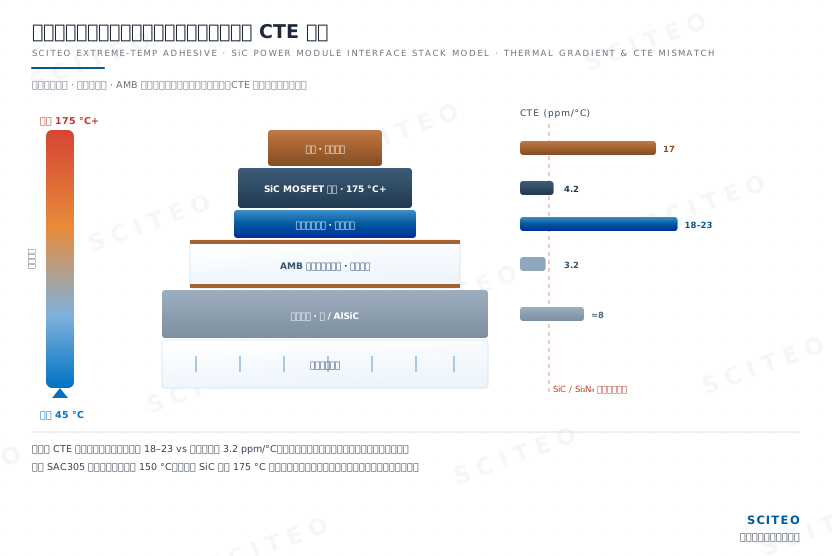
260 °C Reflow: an Entry Ticket, Not the Exam
The reflow peak tests how stiff the adhesive stays, not how long it survives chemically. For an interface material designed for 400 °C service, tens of seconds at 260 °C is normal load. What matters is how far storage modulus drops past Tg, and the CTE gap between the adhesive and the copper foil, the laminate and the component bodies.
The Modulus Cliff Past Tg
The reflow profile typically climbs to 250–260 °C within tens of seconds. Past its Tg, the adhesive enters the rubbery or viscous state and storage modulus plummets by two to three orders of magnitude. Under oven airflow and conveyor vibration, components that have lost their rigid support drift imperceptibly, or detach outright.
Volumetric expansion is the more insidious half. Beyond Tg the adhesive's CTE typically jumps from 30–50 ppm/°C in the glassy state to 120–180 ppm/°C in the rubbery state, while the FR-4 laminate beneath it runs in the teens and the silicon die above it about 3 ppm/°C. The expanding rubbery layer lifts the component vertically, and on cool-down the contraction pulls back as shear. A micro-solder joint under the die goes non-wet; a small copper pad is torn off the board whole. The expensive part is where this hides: under the component and the bondline, out of sight of AOI, so it usually surfaces only at functional test or X-ray sampling.
Why We Specify a Three-Pass Margin
SCITEO's high-temperature adhesives purpose-built for SMT electronics co-optimize high Tg with low CTE: a crosslink network lifts post-cure Tg to 190 °C and beyond, up to 240 °C, while flattening the drop in glassy-state modulus with temperature, and graded low-expansion inorganic fillers hold the glassy-state CTE close to that of the metals and ceramics it bonds. Tested to J-STD-020, the system withstands 3+ consecutive 260 °C reflow passes with no micro-cracking, delamination or peeling at the interface.
The words a line engineer least wants to hear are "a single peak pass is enough." Double-sided mounting sends first-pass components through the oven again, and BGA rework adds another localized thermal shock. That is why we give production lines a three-pass margin, and why test reports carry both the initial strength and the post-three-pass retest instead of the number measured straight out of the oven.
Thermal Cycling and Damp Heat: the Pre-Screen
Cycling and 85/85 will not kill a 400 °C-grade adhesive outright, but they are the pre-screen for extreme duty: the stress still sitting at the interface after hundreds to thousands of cycles decides whether this bondline gets into the high-temperature exam at all.
Read the Fracture Location, Not the Strength Number
Cycling damages by accumulation, not by peak value. Every heat-up and cool-down leaves another installment of residual shear at a dissimilar interface; by the time a few hundred to a thousand cycles have passed, that stress is enough to nucleate micro-cracks and drive them into cohesive failure or interfacial release. Where the fracture sits matters: a break inside the adhesive body is cohesive and points to insufficient toughness in the formulation, while a clean break between adhesive and substrate is interfacial and usually points to surface preparation or wetting. The two call for opposite corrective actions, and reading only the strength number misdiagnoses both.
Automotive sensors and outdoor base stations must pass hundreds or thousands of thermal cycles (−55 °C to 150 °C). Conventional adhesives nucleate micro-cracks after a few dozen cycles and eventually fail cohesively.
85/85 Is a Chemistry Question
Under sustained 85 °C/85% RH bias, conventional adhesives hydrolyze readily, losing bond strength and driving down insulation resistance at the same time, so the mechanical and electrical margins decay together. Damp-heat damage runs on two channels. Moisture ingress breaks the chemical coordination bonds between the adhesive and the metal-oxide surface and disbonds the interface; the absorbed water also raises the dielectric constant and lets residual halide and alkali ions migrate along moisture paths under bias, producing leakage current, electrochemical corrosion and dendrite growth.
SCITEO's full industrial and electronic-grade portfolio uses a dense three-dimensional crosslink network, and its aging data is measured on a thousand-hour scale: 95% interfacial shear retention after 1,000 TC cycles, above 90% after 1,000 hours of 85/85, and high-strength bonding maintained for 30 days at 180–230 °C. In automotive electronics and wide-bandgap power devices, these thousand-hour retention figures predict field life better than room-temperature initial strength.
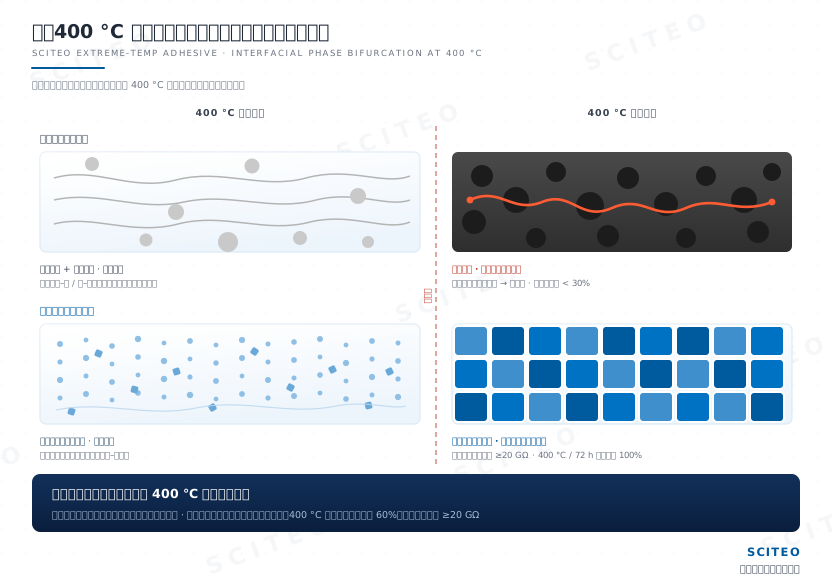
400–1000 °C: When the Interface Is No Longer a Polymer
Past 400 °C the bondline is no longer facing softening; it is facing decay. A conventional epoxy backbone undergoes irreversible main-chain scission and its residue carbonizes into conductive ash. The real problem is not how high a rating can be claimed, but three failure modes the field shares: high-temperature insulation loss, mechanical decay after aging, and attack by water and chemical media.
When applications extend to high-temperature semiconductor quartz boats, dry PVD/CVD processes, high-temperature glass sensing, optical coating and high-power precision ceramic chips, the temperature bar rises sharply. SCITEO moved off a resin-dominated base layer for this tier, with a product line rated for continuous 400 °C to 1000 °C service.
Insulation Loss: Why Heat-Resistant Fillers Turn the Adhesive Conductive
A customer once brought in an adhesive rated to 500 °C and asked why the heating stage tripped the breaker the moment it was powered. Cut the interface open and the layer had become a shiny conductive shell. Insulation fails along two paths at once. Most commercial ultra-high-temperature adhesives load heavy metal powders, graphite or semiconductive refractory oxides as skeleton fillers to fight burn-out, and metastable carriers in that filler hop far more readily under thermal excitation as the microscopic band gap narrows, so the layer turns semiconductive. At the same time, residual organic additives carbonize in a low-oxygen environment and deposit nanoscale carbon black along filler boundaries, building a microscopic conductive network. Together they drive insulation resistance from megohms at room temperature to a few hundred ohms, and electrical isolation is gone.
SCITEO builds a phase-transition structure from a non-carbon precursor that reconstructs in situ into a dense wide-bandgap refractory network, cutting off free-electron transport. Measured insulation resistance stays above 20 GΩ at 400 °C (characterized to GB/T 31838.2 by the volume-resistivity method), and after 72 hours at 400 °C the insulation retention still holds at 60%, providing a stable electrical barrier for high-temperature ceramic heating elements and high-voltage equipment.
The metric is decisive for wide-bandgap packaging. GaN-on-SiC channel design temperatures typically sit between 150 °C and 200 °C, yet UHVDC converter valves, rail-traction converters and high-power industrial drives must hold isolation at higher ambient temperatures and higher bus voltages, so insulation headroom in the bondline directly sets system-level reliability.
Re-Test Shear After 72 Hours at 400 °C, Then Call It Life
In ultra-high-temperature bonding and sealing of dissimilar materials such as quartz glass to stainless steel or ceramic to metal, thermal-stress tearing is the norm. Whether a bondline passes is never judged by its strength out of the furnace, but by the retention that survives aging. Many low-grade high-temperature adhesives cure into a porous body that passes a pull test fresh out of the oven, then fills with micron-scale voids from shrinkage and phase conversion after a few days at 400 °C and crumbles at a touch.
SCITEO's phase-transition architecture shows outstanding thermal stability over 72 continuous hours at 400 °C (per GB/T 7124): interfacial shear strength is unaffected, with no discoloration or mechanical degradation, holding the high-strain interface firmly in place. In our lab these interfaces follow a fixed protocol: visual inspection for discoloration and cracking after removal from the furnace, then shear testing, with both data sets archived together rather than reporting only the room-temperature initial value.
Boiling Water and Aggressive Chemistry: the Seal's Blind Spot
Liquid water and chemical media are the shared weak point of conventional high-temperature adhesives. Silicate systems are strongly hydrophilic and tend to re-dissolve in moisture, while phosphate systems can dissociate in acid or base. SCITEO's measured results on both fronts:
- 100 °C boiling-water resistance: components immersed in 100 °C boiling water for 10+ hours show no swelling, cracking or detachment, covering atmospheric steam cleaning and high-humidity duty. Medical autoclave sterilization runs at 121 °C and above, so it is qualified separately against the higher-temperature grade.
- Extreme chemical inertness: no anomaly after 48 hours in 5% hydrochloric acid or 5% sodium hydroxide, and no anomaly after 48 hours in the strong solvent ethyl acetate, meeting the media-resistance requirements of specialty sensor and detector encapsulation.
200–500 °C High-End Sensing: the Bondline Is a Reference, Not a Fastener
A sensor is judged by its readings: can temperature, pressure, strain and gas concentration be read out faithfully? Once the measured environment crosses 200 °C, the bondline stops being a structural fastener and becomes a reference element: its creep, outgassing and thermal expansion are written straight into the reading as zero-point drift, wavelength shift or degraded signal-to-noise. Failures of this kind often leave no visible trace, only a reading that drifts off by degrees, which is what makes high-end sensing the most demanding exam a high-temperature adhesive can face.
200–300 °C: What Moves a Fiber Bragg Grating's Wavelength Reference
A fiber-optic sensor reads out a wavelength. A fiber Bragg grating (FBG) encodes temperature into the center wavelength of its reflection peak, set by the effective index and the grating period, and the interrogator reads that peak position. The 1550 nm optical-communication band, paired with telecom-grade components, gives the technique a low-cost, EMI-immune readout chain. The difficulty hides in thermal expansion: fused silica has a CTE of only about 0.55 ppm/°C, while the metal package tube (316L stainless steel, roughly 16–17 ppm/°C) and conventional organic adhesives (50–100 ppm/°C) run one to two orders of magnitude higher. Bond the three into one body and every heating and cooling cycle leaves residual shear in the adhesive. That stress relaxes slowly in service and the peak drifts. Part of the temperature the sensor reports is really the adhesive moving.
Products in this class typically pair a high-temperature polyimide fiber with a seamless stainless-steel tube, and every unit is annealed for hours at 20–50 °C above its rated temperature before it ships, releasing packaging stress and letting shallow-level grating defects escape early in exchange for long-term zero-point stability. In that process the adhesive's job is not to hold, but to stay out of the way: Tg must sit well above service temperature to suppress creep, cure shrinkage must be small, and collected volatile condensable materials (CVCM) must be low enough to leave no film on the optical faces.
Across SCITEO's high-Tg epoxy systems for this band, several grades run above 200 °C Tg, and shear strength retention stays above 80% after 1,000 continuous hours at 250 °C. For a fiber device the meaning is direct: within service temperature the adhesive neither softens appreciably nor shifts the grating's boundary conditions through shrinkage or outgassing, so the wavelength reference holds.
300–500 °C: Matching Sapphire Fiber and Silicon Carbide Sensing
Past 300 °C, polymer-coated silica runs out of road: polyimide coatings top out around 300–350 °C long-term, and ordinary Type I gratings suffer thermal decay, reflectivity falling with service time until the signal disappears. The silica itself softens far above 1600 °C; what caps it is the engineering service limit, since a fiber under strain elongates irreversibly from about 800 °C and a germanium-doped core diffuses and devitrifies, so even an unstrained long-term duty stays near 1000 °C. The engineering answer is to change materials: regenerated or femtosecond-written gratings push the operating point to 800–1000 °C, or the sensing element itself becomes single-crystal sapphire fiber.
Sapphire (single-crystal α-Al₂O₃) melts near 2050 °C, has a refractive index of about 1.77, and transmits across 0.23–5.5 μm as a material (drawing and surface losses narrow the usable window on a finished fiber to roughly 0.4–3 μm). Fiber Bragg gratings written directly into sapphire fiber with a femtosecond laser have delivered single-mode temperature response from 25 °C to 1200 °C; single-mode operation has since been extended to 1600 °C, multimode devices have been demonstrated to 1900 °C and run 1,000 hours at 1500 °C, and sapphire photonic-crystal fiber gratings now reach the centimeter scale, clearing a path toward production. The sensing element cleared 500 °C long ago; what decides whether a product ships is the package interface. Sapphire's CTE is roughly 5–8 ppm/°C and anisotropic with crystal orientation, naturally mismatched against a metal tube at 16–17 ppm/°C, so every 100–500 °C cycle deposits another installment of shear in the adhesive.
Silicon-carbide piezoresistive sensing takes a different route. Silicon piezoresistors lose their footing above 150 °C as intrinsic carrier concentration climbs and output drifts; 4H-SiC's wide bandgap pushes the operating point to −50 °C through 600 °C, and a leadless-packaged sensor family reaches 0.18% FSO accuracy with a zero-output temperature coefficient as low as 0.08%/°C. A SiC pressure sensor developed by NASA Glenn with Kulite has run at roughly 500 °C measurement points, with a water-cooled jacket isolating the heat source, and the same leadless package family has since pushed the operating temperature toward 600 °C. In these parts the Wheatstone bridge sits directly on the bondline: if electrical isolation fails, leakage current eats the bridge balance.
Tunable diode laser absorption spectroscopy (TDLAS) pushes the interface to the boundary between optics and fluid. A tunable diode laser sweeps the characteristic absorption lines of H₂O, NH₃ and other species, and a two-line ratio recovers temperature; industrial in-situ analysis already covers furnace and duct temperatures up to 1,500 °C, and laboratory combustion diagnostics reach roughly 1000–3000 K. Sealing the cell window to the metal body must hold both gas integrity and optical-axis alignment; this class of high-temperature sealing leaves less margin than an ordinary structural bond, because conventional organic adhesives carbonize and shrink above 400 °C, tilting the axis and distorting line intensity and baseline together.
For the 300–500 °C class, SCITEO uses a precursor that ceramizes in situ into a dense refractory network at temperature. After 72 continuous hours at 400 °C, shear retention is still 100% and volume insulation resistance stays above 20 GΩ, which is what sapphire interface anchoring and SiC bridge isolation each depend on.
A Criterion You Can Take to a Supplier
What a sensing interface asks of an adhesive comes down to one sentence: hold position at service temperature, without conducting, creeping, outgassing or pushing against the sensing element. Vetting a supplier is more direct than reading a temperature rating: ask for the retention that survives aging, and for how much insulation resistance is left at temperature. Without those two, no temperature rating is enough to carry a selection decision.
Semiconductor High-Temperature Processes and Advanced Packaging: Cleanliness Comes First
Semiconductor manufacturing and advanced packaging ask something different of a high-temperature adhesive: cleanliness comes first, insulation second, temperature third. Inside SiC epitaxy furnaces, dry-etch chambers and PVD/CVD coating cavities, quartz boats, wafer carriers and ceramic insulators sit in 400 °C+ process temperatures and corrosive atmospheres. An adhesive that outgasses or carbonizes into a conductive residue will contaminate the chamber, compromise insulation and even shift thin-film deposition cleanliness.
Three Red Lines Inside the Chamber
Constraining total mass loss (TML) and collected volatile condensable materials (CVCM) per ASTM E595 is the standard way to hold that process line, and SCITEO's low-outgassing, high-insulation ultra-high-temperature adhesive lands exactly where the three constraints meet: low enough not to contaminate the chamber or the viewport, insulating enough to hold isolation, and durable enough to survive repeated process heat. Read the measured TML and CVCM first, then how much insulation resistance is left at temperature, and only then the temperature rating. That order saves most of the rework.
Glass Substrates, TGV and CPO: Process Adhesive vs Structural Adhesive
AI compute keeps pushing advanced packaging toward panel-level processing (PLP) and glass substrates. Glass breaks the bottleneck with a tunable CTE (high-modulus glass cores sit mainly at 3–4.5 ppm/°C, close to silicon at 2.6 ppm/°C), plus low dielectric loss and high flatness. Across glass panels starting at 310 mm × 310 mm and planned to scale to 515 mm × 510 mm, TGV through-glass vias must reach the hundred-thousand to million-hole scale, and laser-induced deep etching (LIDE) already delivers features down to about 5 μm with aspect ratios up to 1:50. Die-to-die interconnect pitch in the HBM4 generation compresses to 25–40 μm, bumps to the interposer move into the 10 μm class, and sub-10 μm interconnect needs hybrid bonding, which the leading houses have now deferred from HBM4E to HBM5. Large-panel edge warpage under thermal cycling can reach tens of microns, already in direct conflict with a micro-bump alignment tolerance typically under 10 μm. CTE mismatch and warpage control are now the core contradiction of next-generation packaging.
Co-packaged optics (CPO) landed on the same timeline: NVIDIA's Spectrum-X photonic switch has entered full production, moving CPO from proof of concept to shipping hardware and tightening the cleanliness and thermo-mechanical constraints on electro-optical package interfaces. Glass-carrier temporary bonding and debonding, and the multi-layer RDL flow on glass-core substrates, all require an interface adhesive that holds dimensional stability, leaves no residue and releases without damage across several hundred degrees of process temperature; long-term device-level anchoring and insulation fall to a high-temperature structural adhesive, and the two material classes must be selected together within one process window. SCITEO's dual-track capability, spanning high-temperature processes and packaging interfaces, gives it the supply depth to carry customers from front-end to back-end as supply chains localize.
Move the Question Forward: Four Questions That Define a High-Temperature Interface
Temperature runs from 260 °C to 1000 °C, applications run from high-end sensors to semiconductor high-temperature processes, and the problem always converges on the same layer: the thin slice of material between two dissimilar surfaces. The value of that interface is not how high its initial strength reads, but whether it still holds the mechanical and electrical state it was delivered with after aging, cycling and damp heat.
Selection can be moved forward. Four questions put to a supplier are worth more than any scan down a temperature column: after 72 continuous hours at 400 °C, how much shear retention is left; at the same condition, how much insulation resistance is left; how many digits were measured for CVCM and TML; and after a thousand cycles, did the fracture run through the adhesive body or along the interface. The first three questions screen the material; the last one screens the process.
From high-Tg epoxy to ceramized phase-transition systems, SCITEO's full-temperature-range portfolio is selected against the same requirements: the compound redundancy of insulation retention, post-aging shear retention and CTE matching. Years of extreme-condition data from energy, semiconductor and high-end manufacturing customers keep pointing to the same conclusion.
This article is SCITEO Advanced Materials original technical content; unauthorized reproduction is prohibited.
Appendix: Process & Engineering Adhesive FAQ Index
Why do high-temperature adhesives rated above 400 °C often turn conductive once power is applied?
To resist burn-out at extreme temperatures, conventional products use metal powders, graphite, or semiconductive refractory oxides as the skeleton filler, and the formulation still carries the organic additives needed for room-temperature application. Past 300–400 °C, free carriers in the filler hop more readily, while the residual organic phase carbonizes in a low-oxygen environment, depositing nanoscale carbon black along filler boundaries and building a microscopic conductive network. Insulation resistance collapses from megohms at room temperature to hundreds of ohms, or to outright conduction. Our approach removes the free conductive phase from the formulation and rebuilds the interface from a non-carbon precursor that reconstructs in situ into a dense wide-bandgap ceramic, cutting off electron transport: measured volume insulation resistance still holds above 20 GΩ after 72 hours at 400 °C.
What does a datasheet claim of 'survives three reflow cycles without cracking' actually solve on the line?
It eliminates the latent damage of double-sided assembly and rework. High-density PCBAs require double-sided mounting, so components bonded on the first pass must re-enter the 260 °C reflow zone. If a BGA needs hot-air rework, the surrounding adhesive takes another localized thermal shock. Ordinary adhesives typically sit below a 150 °C Tg, and on the second pass the rubbery expansion lifts copper pads or delaminates the die from the substrate. SCITEO locks the cured system's Tg at 190–240 °C, so it keeps structural support through the 260 °C peak; after three or more thermal shocks, shear strength is unchanged with no delamination, preventing the latent failures that accumulate across process steps.
Why is post-aging shear retention more decisive than initial bond strength at 400 °C?
Because at 400 °C a conventional adhesive's carbon backbone degrades thermo-oxidatively within minutes to hours, turning brittle, micro-cracking, or pulverizing. Even 30 MPa of initial strength is meaningless once the structure collapses. After 72 hours at 400 °C the SCITEO system not only avoids degradation, it reconstructs into a denser high-temperature network for 100% interfacial shear retention, true zero mechanical decay. The same retention logic governs qualification here: 95% after 1,000 TC cycles and above 90% after 1,000 hours of 85/85 damp-heat aging.
Where exactly is the temperature limit for conventional epoxy, and how does SCITEO's non-carbon phase-transition architecture cross the 350 °C to 400 °C threshold?
The limit is the thermo-oxidative scission rate of the main chain, not Tg. Even on high-performance backbones, carbon–carbon and carbon–oxygen bond breaking accelerates above roughly 350 °C to 400 °C of continuous service, collapsing structural integrity regardless of initial Tg. SCITEO takes a different route at the molecular level: a non-carbon precursor plus ceramizing fillers, where the precursor state reconstructs in situ into a dense refractory ceramic network at temperature. This frees temperature resistance from the chemical boundary of conventional resin systems while maintaining insulation with no free-electron migration path.
In high-end sensor packaging at 200–500 °C, what does the bondline have to deliver beyond temperature resistance?
Four requirements must hold at once. Dielectrically it must not conduct, or leakage current rewrites the balance of a 4H-SiC piezoresistive bridge. Mechanically it must not creep, or the wavelength reference of a fiber Bragg grating drifts through service life. Chemically it must not outgas, or a film forms on optical faces and cell windows, distorting TDLAS line intensity and baseline together. Thermally it must not push against the sensing element, so the CTE gap between sapphire at roughly 5–8 ppm/°C and a stainless-steel housing at 16–17 ppm/°C is absorbed inside the adhesive. SCITEO covers all four with 100% shear retention after 400 °C/72h, volume insulation resistance still above 20 GΩ, and CVCM below 0.01%.
How do sapphire fiber and silica fiber split the work in high-temperature sensing, and where does the adhesive come in?
Silica fiber's long-term operating point usually lands in the 300–500 °C class: its own softening point sits far above 1600 °C, but the engineering service limit is roughly 1000 °C, and under strain it elongates irreversibly from about 800 °C. Polyimide coatings cap out around 300–350 °C, while regenerated and femtosecond gratings reach 800–1000 °C. Single-crystal sapphire fiber melts near 2050 °C, and femtosecond-written gratings have delivered single-mode response from 25 °C to 1200 °C, with single-mode operation since extended to 1600 °C and multimode devices running 1,000 hours at 1500 °C. The split is therefore clean: quartz systems below 400 °C, sapphire or 4H-SiC sensing elements above it. Either route still has to manage one to two orders of magnitude of CTE mismatch between the fiber core and the metal housing at the package interface, and that is the adhesive's share of the problem.
In next-generation advanced packaging such as glass substrates, TGV interposers, and CPO co-packaging, how do high-temperature structural adhesives and temporary bonding adhesives split the work?
They serve the same interface at different process stages. A glass-carrier temporary bonding adhesive fixes the wafer or panel during TGV drilling, multi-layer RDL patterning, thinning, and high-temperature cure, and must deliver high flatness, clean debonding, and low residue. A high-temperature structural adhesive handles long-term device-level anchoring and insulation, holding dimensional stability without outgassing or carbonizing across several hundred degrees of process temperature and the thermal cycling that follows. As panels start at 310 × 310 mm and scale toward 515 × 510 mm while TGV via counts per panel move into the hundred-thousand to million range and die-to-die interconnect pitch in the HBM4 generation compresses to 25–40 μm, with sub-10 μm interconnect waiting on hybrid bonding in a later generation, warpage and CTE mismatch become the core contradiction, so both material classes must be selected together within one process window.